
Plate F2 · Chapter 6
Maple spinner
A paper maple seed that spins as it falls
Spinner · drop from highClassic design · our version not yet measured
Print this design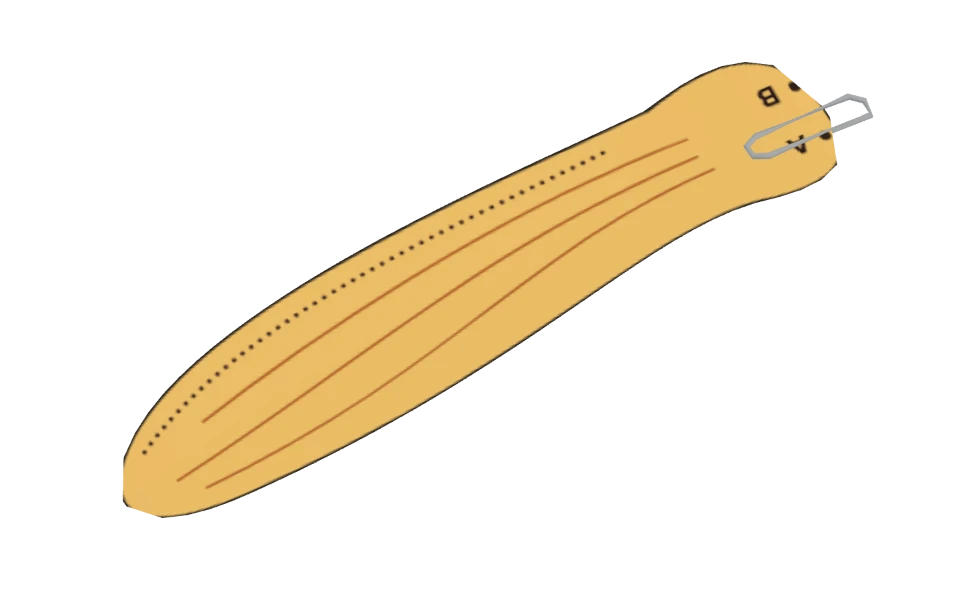
At a glance
- Wing
- 121 mm, cut from the sheet
- Clip
- One small metal clip, at A or B
- Drop height
- At least 1.5 m; a tall helper with an arm raised, about 2 m
- Spins around
- a point about 26 mm from the root estimate
- Turns per drop
- Count them: no record yet not yet measured
How it spins
A maple seed is one wing with a heavy seed at its root. Your clip is the seed. Let go, and the wing starts to spin like a helicopter blade.
When you let go, the heavy end leads and the wing tilts. Air pushing on the tilted, curled wing makes it turn.
Once it turns, the whole wing sweeps through the air like a helicopter blade, and the air pushes up on it. That push slows the fall. It spins around its balance point, close to the clip, and the wing rises a little toward the tip, tracing a cone.
Drop it from at least 1.5 m. From lower, it may land before it starts to spin.
Make it
What you need The maple wing template, scissors and one small metal paper clip. A helper can cut the outline.
-
Step 1 / 4
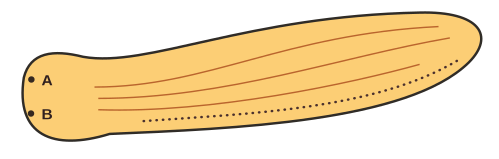
Cut along the solid line around the printed wing. Keep the wing and its rounded root in one piece.
-
Step 2 / 4
Slide the clip onto the short edge at dot A. Its long side should lie flat on the paper.
-
Step 3 / 4
With the printed side up, lift the dotted long edge slightly with your fingers to give the wing a shallow curl.
-
Step 4 / 4
A tall helper holds the wing tip as high as they can, about 2 m and never lower than 1.5 m, clip pointing down, and opens their fingers. Watch for complete turns.
Launch it
Hold the tip of the wing with the clip pointing down. Hold it as high as you safely can: a tall helper with an arm raised, about 2 m, never less than 1.5 m. Open your fingers without pushing. Watch from the side, then lie down and watch from below.
Trim it
| If it… | Try this |
|---|---|
| Falls straight down | Drop it from higher. Then curl the dotted edge a little more. |
| Flutters or tumbles | Put the clip at A, nearer the front edge. |
| Spins but falls fast | Use lighter paper or a smaller clip. Flatten the outer half of the wing. |
| The clip slips | Push it on further, flat against the paper. |
What to try. These fixes follow how paper gliders behave. They have not yet been tested on this design.
Why it exists
A seed that travels
Maples, sycamores and ash trees make winged seeds called samaras. A maple seed spins as it falls, so it falls slowly and the wind can carry it away from its parent tree.
Scientists found a small whirl of air along the front edge of the spinning wing. It raises the lift, as similar whirls do for hovering insects. Real samaras keep spinning even after losing up to about 40% of their wing area.
Our spinner borrows the heavy root and the single curved wing of a maple key.
Try this
Where should the clip go?
Predict first. Which clip position spins more often: A, nearer the front edge, or B, nearer the curled back edge? A wing balanced toward its front edge is usually steadier, so our guess is A.
- Curl the dotted edge the same way for every drop.
- Clip at A. A tall helper drops it five times from the same height, at least 1.5 m.
- Move the same clip to B and drop five more times.
- Count full turns each time, including zero.
What to look for. Which position gives more turns and a slower fall, and whether one of them tumbles.
Go deeper
Each section of the wing meets air that combines its circular motion with the upward flow of the fall. Over much of the span the resulting force tilts forward and drives the rotation, while drag near the root resists it. Steady autorotation, a spin that the falling air itself keeps going, balances the two, and the vertical force balances the weight. NASA Glenn's activity explains that the seed's centre of mass sits near one end while its centre of lift is near the middle, and that the rotation traces a cone around the axis of fall.
Lentink and colleagues (2009) showed a stable leading-edge vortex on spinning maple seeds, which raises their lift. Schaeffer and colleagues (2024) found that descent speed follows a simple drag balance on the wing area seen from below, and that samaras keep autorotating after losing up to 40% of their wing area, with descent speed changing by less than 15% when their mass more than doubles.
Clip stations A and B sit 4.4 and 13.4 mm from the front edge across the 16.3 mm root, so moving the clip shifts the balance across the chord. With a 0.3 g clip on 80 g/m² paper, our estimate puts the balance about 26 mm from the root. These are estimates from the printed shape.
Sources
- Vogt, G. (Oklahoma State University, Aerospace Education Services Project), ed. R. Storm, NASA Glenn: “Maple Seed” Helicopters · The original activity, the 5 ft (1.5 m) drop and the cone. Open Flight drew a new outline. Linked.
- Lentink, D., Dickson, W. B., van Leeuwen, J. L. & Dickinson, M. H. (2009). Leading-edge vortices elevate lift of autorotating plant seeds. Science 324: 1438–1440 · The leading-edge vortex on maple seeds. Cited only; no figures reused.
- Schaeffer, B. M., Truman, S. S., Truscott, T. T. & Dickerson, A. K. (2024). Maple samara flight is robust to morphological perturbation and united by a classic drag model. Commun. Biol. 7: 248 · Robustness and the drag model; Fig. 2 may be reused with credit. CC BY 4.0.
- Acer rubrum seed keys, Dcrjsr (2012), Wikimedia Commons · The seed photo on this page. CC BY 3.0; resized.
