
Plate F1 · Chapter 6
Ring glider
A ring wing rolled from one sheet
Ring wing · overarm releaseClassic design · our version not yet measured
Print this design
At a glance
- Paper
- One plain A4 or US Letter sheet. No printing needed.
- Rim
- Two 13 mm folds (NASA/JPL uses one)
- Ring across
- about 95–100 mm on Letter estimate
- Balance point
- about 46 mm behind the front edge estimate
- Recorded flights
- None yet for our version not yet measured
How it flies
The ring glider is a wing bent into a loop. The rolled rim makes the front heavier, and the paper behind it steers like the feathers of a shuttlecock.
The rolled rim at the front is the thickest part, so the ring balances near the front. The paper trailing behind works like the feathers of a badminton shuttlecock: if the nose tips up, down or sideways, the air pushes on the tail and lines it up again.
As it flies a little nose-up, the top and bottom of the ring push air down, and the air pushes the ring up. The sides act like fins and keep it straight.
Make it
What you need No printing needed: one plain A4 or US Letter sheet (write down which) and a ruler. A small piece of tape is optional.
-
Step 1 / 4
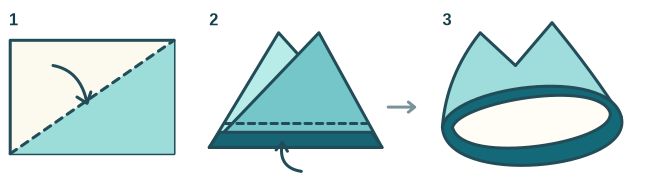
Lay the sheet sideways. Fold along the diagonal between opposite corners. The other two corners form two separate peaks.
-
Step 2 / 4
Fold the long folded edge over by about 13 mm, then once more by the same width. NASA/JPL folds it once; the second fold adds weight at the front.
-
Step 3 / 4
Bend that thick edge into a ring with the folded strip on the inside. Tuck one end into the fold of the other, or add a small piece of tape.
-
Step 4 / 4
Hold the ring at the bottom of the V between the peaks, two fingers inside and your thumb outside, rim forward. Reach your arm back, swing it up and let go gently beside your ear.
Launch it
Find the V between the two peaks. Hold the ring at the bottom of the V, two fingers inside and your thumb outside, with the rolled rim forward. Reach your arm back, swing it up and let go gently when your hand is beside your ear.
Trim it
| If it… | Try this |
|---|---|
| Dives | The front is too heavy. Unroll one rim fold. |
| Climbs, slows and falls back | Launch more gently. Add a rim fold. |
| Wobbles or turns | Make the ring round. Smooth the tuck so nothing sticks out. |
| The ring opens | Tuck deeper, or add one small piece of tape. |
What to try. These fixes follow how paper gliders behave. They have not yet been tested on this design.
Why it exists
A classroom classic
The ring glider is a classroom classic. NASA’s Jet Propulsion Laboratory uses it to ask whether a ring with a smaller or larger opening flies farther. A 1990 teachers’ guide, Of Wings and Things, already had a ring-wing activity.
Spinning ring toys such as the X-Zylo are steadied by spin. Your ring has no spin, so its tail does that job.
Our ring follows the JPL fold and launch, with a second rim fold to try.
Try this
Does a smaller ring fly farther?
Predict first. Which flies farther: a ring about 100 mm across or one about 70 mm across? The small ring has the same paper in a shorter loop, so it is heavier for its size and flies faster.
- Make two rings from the same paper. Tuck one deeper so its opening is about 70 mm.
- Measure both openings and write them down.
- Launch each five times from the same line, with the same swing.
- Mark every first touchdown.
What to look for. Which set of marks lands farther, and which one flies straighter.
Go deeper
Folded on its diagonal, a US Letter sheet makes a rim about 353 mm long with the two peaks 132 and 221 mm along it. Rolled into a ring about 95–100 mm across, the peaks sit about 106° apart and trail up to 145 mm behind the rim. Two 13 mm rim folds hold about 28% of the paper; our estimate puts the balance point about 46 mm behind the front edge. These are geometry estimates, not measurements.
The paper ring is stable in pitch and yaw because the air force on its long tail acts behind its balance point, like an arrow’s fletching. A perfectly round ring has no preferred roll angle; the two peaks break that symmetry. For the same span and lift, a closed wing can have less induced drag than a single flat wing (Prandtl, 1924), but it adds surface and friction drag, which matters a lot at paper-glider speeds.
Sources
- NASA/JPL Education, Make a paper glider (ring wing) · Build, grip and launch, and the diameter experiment. Paraphrased with credit; no images copied.
- NASA/JPL Education, The Ring Wing Glider (lesson) · Classroom lesson. Linked; its printable template stays link-only.
- Of Wings and Things (1990), a teachers’ guide (ERIC ED360170) · An early ring-wing activity for teachers. Linked.
- Prandtl, L. (1924). Induced drag of multiplanes. NACA TN 182 · Closed and box wings and induced drag. Public NASA record.
- Wagner (2021). Theoretical and experimental investigation into the flight of an X-Zylo. arXiv:2102.02647 · A spinning ring wing, modelled and tested. CC BY 4.0.