
Plate B2 · Chapter 5
Blue morpho
An experimental paper glider with a blue morpho’s wings
Experimental glider · smooth pushExperimental glider · awaiting flight test
Print this design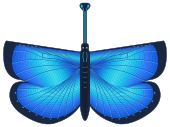
At a glance
- Paper
- 120 g/m², wings along the long side
- Clips
- Two 33 mm metal clips
- Wingspan
- 164 mm
- Balance point
- 51 mm behind the nose estimate
- Glide speed
- about 2.5 m/s estimate
- Recorded flights
- None yet not yet measured
How it flies
Your butterfly is a glider with no tail. Its wings must hold it up and keep it steady, so where it balances matters more than anything else.
Two points matter. The balance point is where it balances on your fingertips. The lift point is where the air pushes up on the wings, on average. On this butterfly our model puts the balance target 51 mm behind the nose and the lift point 58 mm behind it: 7 mm apart, balance first. When the balance point is a little in front of the lift point, the butterfly glides steadily. When it is behind, the nose rises, the butterfly slows and drops.
The two clips on the head move the balance point forward. The long head works as a lever, so two light clips are enough. Real butterflies do not have long necks; ours needs one to balance.
The tabs at the back set the angle. Bent up a little, they make the air push the tail down, so the nose lifts and the wings can make lift. The V shape of the wings helps it roll back to level.
This is an experimental glider, our second attempt. Our first fold glided poorly in two early builds by the founder; that was an observation, not a recorded trial. This version moves the balance forward. Nobody has flown it in a recorded test yet. Build it and tell us how it flies.
Make it
What you need 120 g/m² paper, scissors, ruler and two 33 mm clips
-
Step 1 / 8
Cut
Cut the outside line, including the edge strips and the antenna clubs. Cut the four short slits at the back of the hindwings.
One piece. Each hindwing has a tab between two slits.
-
Step 2 / 8
Score
Lay a ruler on each dashed line and press along it with an empty ballpoint pen.
Every fold line shows a groove. Thick paper now folds cleanly.
-
Step 3 / 8
Fold the costa
Fold each edge strip under its wing along its dashed line. Press it flat.
The front edge is straight and doubled, like the costa vein of a real wing.
-
Step 4 / 8
Fold the body
Fold in half on the dashed centre line, colors inside. Then fold each wing back out on its dash-dot line.
The two body layers hang underneath and touch.
-
Step 5 / 8
Clip the head
Slide both clips onto the head over the two body layers, one on top of the other, all the way to the nose.
The clips stay inside the dashed clip box.
-
Step 6 / 8
Balance
Rest the wings on two fingertips under the ringed dots. Tail drops: add a clip. Nose drops: slide a clip back, or remove one.
It stays level on your fingers.
-
Step 7 / 8
Set the V
Lift both wings into a shallow V. Look from the tail and compare each wingtip with the strip.
Both tips are the same height.
-
Step 8 / 8
Launch and trim
Push it smoothly forward, nose level, about as fast as a jog. Dives: bend both tabs up 1–2 mm. Swoops up and stalls: flatten them.
Turns left: bend the right tab up a little. Turns right: the left tab.
Launch it
Hold the body under the wings between finger and thumb, nose level. Stand still in a room without draughts. Push forward smoothly, about as fast as a jog, and let go. Do not throw it upward. Mark where it first touches the floor.
Trim it
| If it… | Try this |
|---|---|
| Dives into the floor | Bend both tabs up 1–2 mm. Still diving: slide one clip back a little. It must still balance on the dots. |
| Swoops up, slows, then drops | Flatten both tabs. Check that it balances on the dots. |
| Turns to one side | Bend the tab on the outside of the turn up a little: the right tab for a left turn, the left tab for a right turn. |
| Drops straight after launch | Push a little faster. Then check the tabs. |
| Rolls over or spirals | Check both tips on the strip: same height. Then raise both a little. |
| The wings flap or droop | Use 120 g/m² paper with the wings along the long side. Try a smaller span. |
What to try. These fixes follow how paper gliders behave. They have not yet been tested on this design.
Field notes
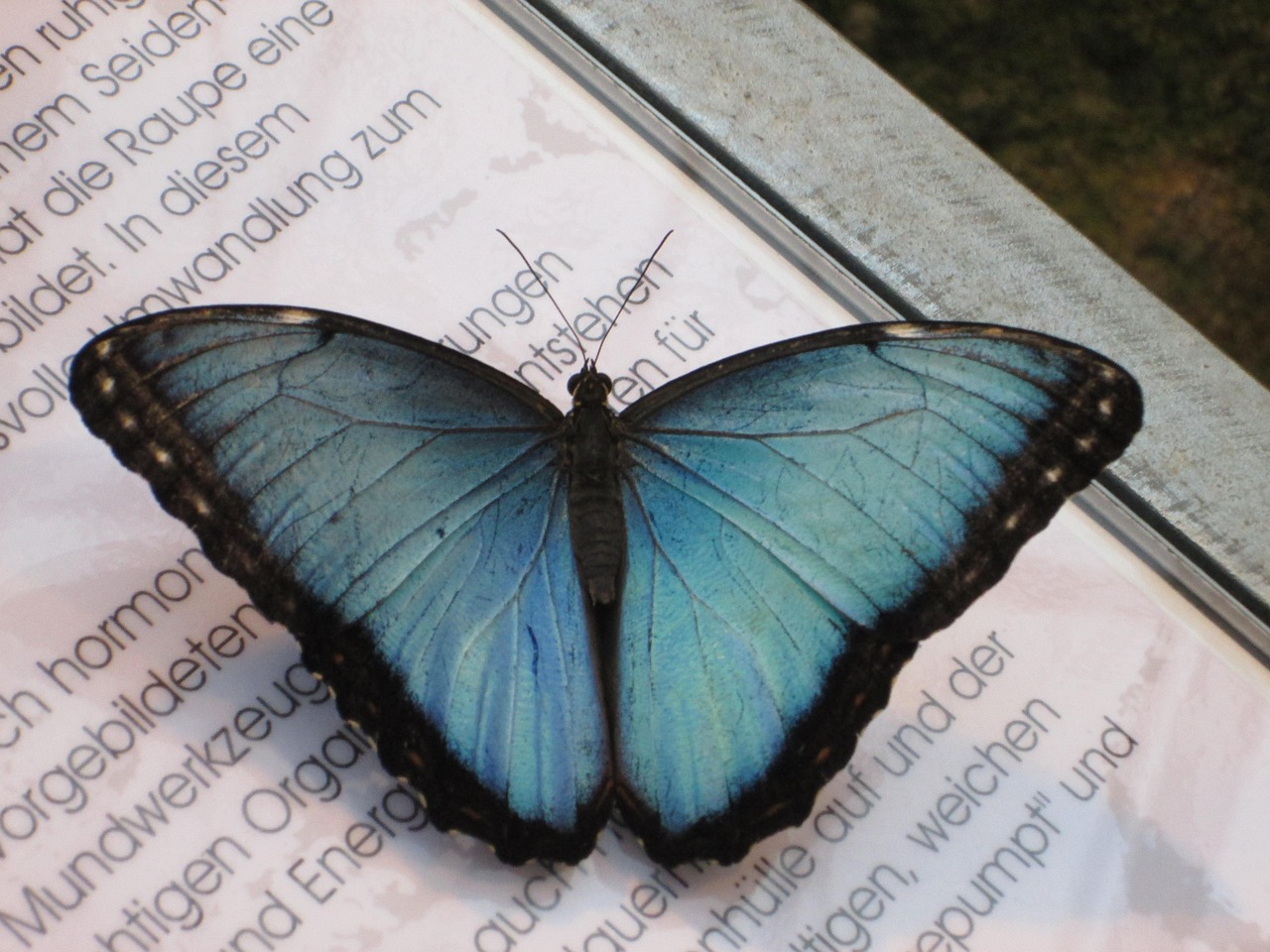
A blue that is not paint
The blue of a morpho is not pigment. Tiny ridges on each wing scale reflect blue light, so the wings flash as they turn. Underneath, the wings are brown with eyespots, so a resting morpho almost disappears.
Scientists who filmed Morpho butterflies found that species living high in the forest canopy glide more efficiently, while species near the forest floor flap harder and fly fast and twisting. Adult morphos feed on fallen fruit.
Our paper morpho has the broadest wings of the three and the steepest V.
Try this
Does the V help it roll back to level?
Predict first. Which setting rolls back to level after a tilted launch: flat wings, or the full V? Our guess is the V.
- Set the wings flat: tips level with the body.
- Hold it with the left wing 10 mm lower than the right and launch gently. Do this five times.
- Set the full V: tips 23 mm above the body, checked with the strip.
- Launch five more times with the same tilt.
What to look for. Whether each launch levels out or keeps turning, and which way it turns.
Go deeper
A glider with no tail flies steadily when its balance point is in front of its neutral point, the spot where extra lift acts when the nose tips up. On a flat wing that spot sits about a quarter of the way back from the front edge, averaged over the wing’s area. The gap between the two points, as a share of the wing’s average depth, is called the static margin. Our flat-wing model gives the first fold (K1) a margin of -13% on 80 g/m² with one clip: not steady. It gives this second version (K2) +10% with two 33 mm clips on 120 g/m² paper.
Being steady is not enough. A perfectly flat wing balanced in front of its neutral point can settle only where it makes no lift, so it dives. Bending the tabs at the back up a little, which engineers call reflex, makes the air push the tail down, so the wing glides nose-up and makes lift. Tailless aircraft solve the same problem with bent-up back edges, swept wings and twisted wings. Early in aviation, Igo Etrich and Franz Wels built a tailless glider modelled on the winged seed of the vine Alsomitra macrocarpa, then called Zanonia.
Each square metre of wing holds up about 2.3 newtons of weight (2.3 N/m²). At a lift coefficient of 0.6, a measure of how hard the wing works, that predicts a glide near 2.5 m/s, about a jog, which is why the launch is a smooth push at jogging speed, not a walk. Paper bends: with the grain along the span, the model predicts the tips bend about 7 mm in a steady glide (1 g) on 120 g/m² and about 16 mm on 80 g/m². Every number here is a model estimate, not a measurement.
Earlier folds
Our first two constructions stay available for comparison: rear wing tabs (W1) and a pinched spine (K1). In two early builds, K1’s wings bent and it glided poorly. That was an observation, not a recorded trial. K2, on this page, is our second attempt.
Sources
- Natural History Museum, Spotlight: blue morpho · Structural colour and the brown underside. Linked and paraphrased.
- Área de Conservación Guanacaste, Morpho peleides · Habitat and food. Linked and paraphrased.
- Le Roy, C. et al. (2021). Adaptive evolution of flight in Morpho butterflies. Science 374: 1158–1162. doi:10.1126/science.abh2620 · Canopy species glide more efficiently; understory species flap harder. Cited only.
- Open Flight, K2 butterfly airframe: model and trial plan (docs/research/butterfly-k2-airframe.md) · Our model and its limits. CC BY-SA 4.0.
- NASA Glenn Research Center, Beginner’s Guide to Aeronautics · Lift, balance and stability. US government text: paraphrased, linked.
- Li, Goodwill, Wang & Ristroph (2022). Centre of mass location, flight modes, stability and dynamic modelling of gliders. J. Fluid Mech. 937, A6. doi:10.1017/jfm.2022.89 · Moving the balance point turns a glide into a dive or a tumble. CC BY 4.0.