
Plate A3 · Chapter 4
Tailwind
A swept, steady flyer after the Ilyushin Il-62
Straight flyer · steady throwOpen Flight fold · not yet measured
Print this design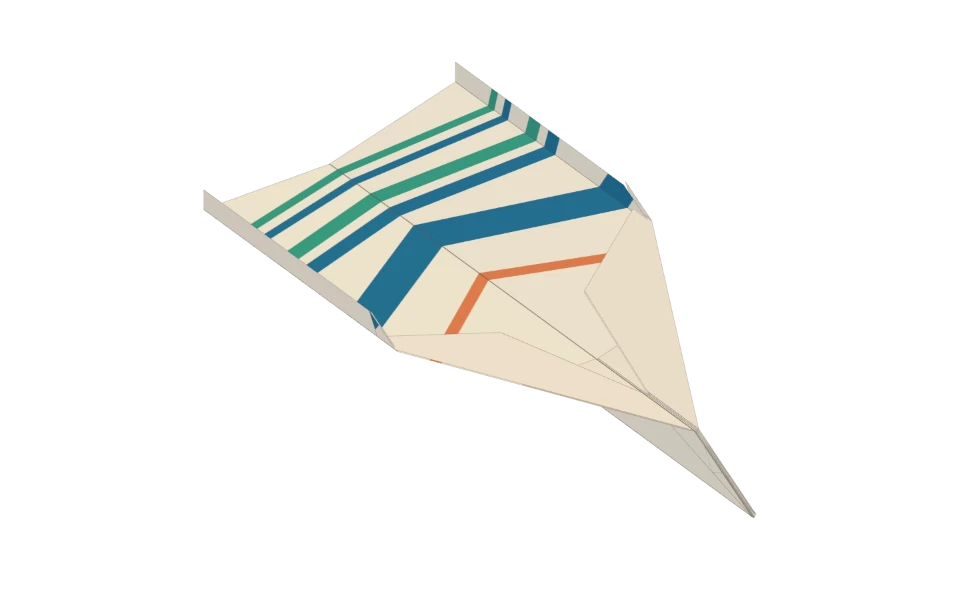
At a glance
- Build time
- 15–20 min · 7 steps estimate
- You need
- 1 sheet of A4 or US Letter · scissors · a ruler
- Balance point
- 135 mm behind the nose (A4) estimate
- Span
- 132 mm, tips folded up (A4) estimate
- Expected flight
- Straight flyer · steady throw · untested estimate
How it flies
Tailwind sits between the dart and the glider. Its tall tips keep it pointing into the air, like the feathers on an arrow.
A folded band adds weight to the front edge. Two folds sweep the wings back. Your throw starts it, then it glides while weight pulls and drag slows it.
Its 10 mm tips are the tallest in the fleet. They sit behind the balance point. If the nose swings to one side, the air pushes on the tips and swings it back.
The thing that matters most is equal tips. If one tip stands taller or leans, it steers the plane like a rudder. Folded on A4, it should balance about 135 mm behind the nose. This design is untested. Tell us how it flew.
Make it
What you need One rectangular sheet and a ruler. You can start with plain paper.
-
Step 1 / 7
Find the centre
Cut out the sheet along the thick border. Print side up. Put the short edge at the top. Bring the two long edges together, press the middle crease, then open the sheet again.
-
Step 2 / 7
Weight the front edge
Fold the top edge down to the 36 mm mark. This makes an 18 mm band across the sheet.
-
Step 3 / 7
Fold the hemmed corners
Using the new front edge, fold both corners to the centre. Smooth each thick diagonal outwards from the tip.
-
Step 4 / 7
Shape the swept shoulders
Fold each sloping shoulder inward on line 4. The crease runs from the nose to a mark 160 mm down each side from the new front. The folded edges stay apart.
-
Step 5 / 7
Close the body
Keep the folded details face up. Fold the right half away from you, behind the left, along the centre line. The folded details will be on the outside.
-
Step 6 / 7
Fold one wing, then match its twin
Hold the closed body with the centre edge on your right. Fold only the upper wing outward on the line 22 mm from that edge. Turn the model over and fold the other wing to match. From behind, the wings make a T with the body hanging below.
-
Step 7 / 7
Raise the wing tips
Lift each wingtip about 10 mm above the body fold. Turn up the outer 10 mm of each long side until both tips stand upright. Sight from the tail and match the heights.
Launch it
Pinch the body under the wings and hold it level at shoulder height. Throw at a steady, medium speed, as if you were passing a ball to someone 3 m away.
Trim it
| If it… | Try this |
|---|---|
| Turns either way | Look from behind first. Both tips should stand straight up and measure 10 mm. A leaning tip works like a rudder. |
| Dives into the floor | Bend up the back 15 mm of each wing, next to the body, until the back corner sits 1 mm above the wing. Still diving: bend 1 mm more. |
| Swoops up, stops, then drops | Flatten the back edges a little and throw more gently. Still swooping: slide a paper clip onto the nose. |
| Rolls over and spirals down | Lift each tip to about 10 mm above the body fold, both at the same height. |
| Rocks from side to side | Flatten the V a little and check that the tips stand upright. |
What to try. These fixes follow how paper gliders behave. They have not yet been tested on this design.
Why it exists
Why it exists
Tailwind is an Open Flight variation that mixes two families. The folded front band comes from gliders. The swept shoulders come from darts.
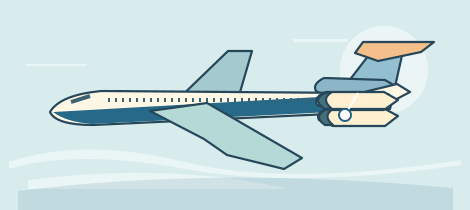
Its name points to the Ilyushin Il-62, a long-range jet that first flew in January 1963. The Il-62 carried its four engines at the tail. With so much weight at the back, an empty Il-62 could tip onto its tail on the ground, so it lowered a small extra strut under the tail when parked. Balance matters for every aircraft. The paper plane has no engines and no tail. The paired stripes on its wings are a reminder of the engines.
It borrows the Il-62’s swept wing and its lesson about balance.
Try this
Are tall tips worth it?
Predict first. Predict first: which lands inside the lane more often? Our prediction is the copy with tips. Its wings are 20 mm shorter, though, so it may land a little sooner.
- Fold one Tailwind with flat tips and one with 10 mm tips.
- Lay a 1 m wide lane on the floor with two strings.
- Give each five level launches from the same spot.
- Record every landing left or right of the lane.
- Change no other fold until you have compared both.
What to look for. Look for a straight flight inside the lane. A turn means a tip is leaning: check both from behind.
Go deeper
Tailwind’s aspect ratio, a measure of how long and slim a wing is, is 0.75, and its front edges sweep back at 58.5°. The balance point sits 28 % of the way along the wing’s average depth. That is between the neutral point from a simple flat-wing model (118 mm, 18 %) and the middle of the wing area (175 mm, 50 %), so the plane should be just steady at gliding angles. A hard throw makes the wing meet the air at a flatter angle, moves the push of the air forwards and may make it climb. The tips keep the nose pointing into the wind, like a weathervane, and stop air spilling round the wing ends. Because they stand above the wing, they also help the V roll the plane back to level. The deep 22 mm body below the wing works the other way: side area below the balance point makes it a little slower to level. Flattening the tips gives 15 % more span and 10 % more wing: a slower sink, but a less straight path. All of these figures are estimates from the fold geometry.
Contest category: accuracy and target flying, and indoor distance from a steady throw.
Sources
- NASA Glenn Research Center · Beginner’s Guide to Aeronautics: Wing geometry · Span, area, aspect ratio and dihedral.
- NASA Glenn Research Center · Beginner’s Guide to Aeronautics: Aircraft rotations · Pitch, roll and yaw.
- NASA Glenn Research Center · Beginner’s Guide to Aeronautics: Aircraft center of gravity · Where the weight acts, and how to find it.
- State Aviation Museum, Kyiv · Il-62 · The real aircraft, with its four engines at the tail.