
Plate A1 · Chapter 4
Upper Deck
A broad paper glider after the Boeing 747
Glider · gentle throwOpen Flight fold · not yet measured
Print this design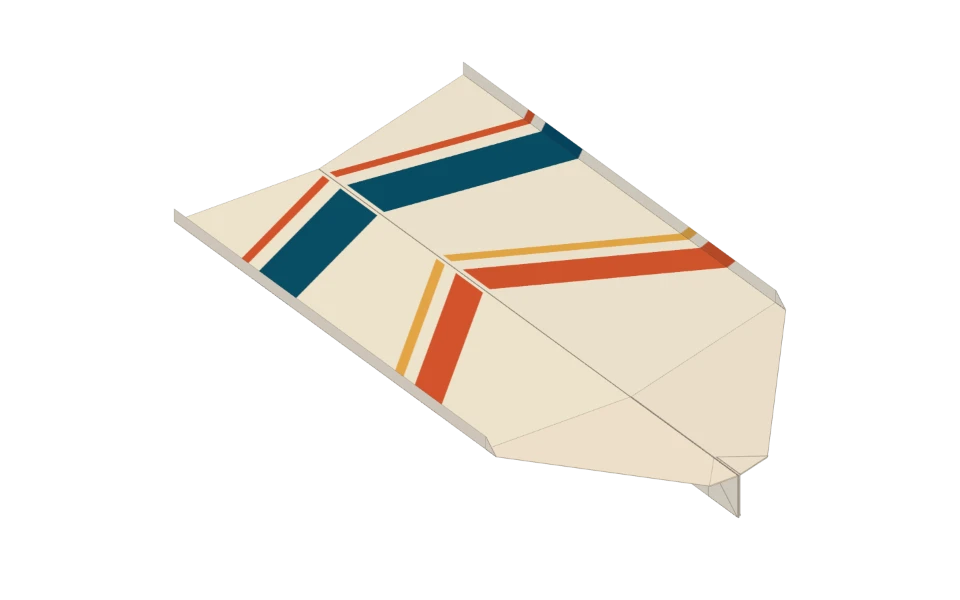
At a glance
- Build time
- 15–20 min · 7 steps estimate
- You need
- 1 sheet of A4 or US Letter · scissors · 1–2 paper clips
- Balance point
- 114 mm behind the nose (A4) estimate
- Span
- 144 mm, tips folded up (A4) estimate
- Expected flight
- Slow glider · gentle throw · untested estimate
How it flies
Your throw is the only push. Then Upper Deck slides down through the air, like a sledge on a gentle slope.
Weight pulls the plane down. The wings turn that fall into a long, slow slide. Drag, the rub of the air, slows it.
The thing that matters most is balance. Upper Deck has short, broad wings, and the air lifts them near the front. So the weight must sit far forward too. The nose step folds six layers of paper into the first 17 mm.
Folded on A4, it should balance about 114 mm behind the nose. Our estimate says that may be a little too far back, so keep a paper clip ready. If it climbs and stalls, slide the clip onto the nose before you bend the back edges. This design is untested. Tell us how it flew.
Make it
What you need One rectangular sheet and a ruler. You can start with plain paper.
-
Step 1 / 7
Find the centre
Cut out the sheet along the thick border. Print side up. Put the short edge at the top. Bring the two long edges together, press the middle crease, then open the sheet again.
-
Step 2 / 7
Bring the corners to the centre
Fold each top corner inward. Lay the two short top edges along the centre crease. Press the two diagonals.
-
Step 3 / 7
Turn the nose down
Fold the pointed nose towards the tail on line 3. The tip rests 68 mm from the original top edge. Press across all the layers.
-
Step 4 / 7
Make the upper-deck pleat
Lift only the loose triangular tip. Fold it back towards the nose on line 4 until its point touches the new front edge. The lower layers stay flat.
-
Step 5 / 7
Close the body
Keep the folded details face up. Fold the right half away from you, behind the left, along the centre line. The folded details will be on the outside.
-
Step 6 / 7
Fold one wing, then match its twin
Hold the closed body with the centre edge on your right. Fold only the upper wing outward on the line 20 mm from that edge. Turn the model over and fold the other wing to match. From behind, the wings make a T with the body hanging below.
-
Step 7 / 7
Raise the wing tips
Lift each wingtip about 10 mm above the body fold. Turn up the outer 6 mm of each long side until both tips stand upright. Sight from the tail and match the heights.
Launch it
Pinch the body under the wings, near the balance point. Hold it at shoulder height, nose level, and push it forward smoothly at walking speed. Do not throw hard: broad wings climb, slow down and drop when they go too fast.
Trim it
| If it… | Try this |
|---|---|
| Swoops up and drops | Slide one paper clip onto the nose before you touch the back edges. With one clip it should balance about 103 mm behind the nose (estimate). |
| Dives into the floor | Bend up the back 15 mm of each wing, next to the body, until the back corner sits 1 mm above the wing. Still diving: bend 1 mm more. |
| Rolls over and spirals down | Lift each tip to about 10 mm above the body fold, both at the same height. |
| Turns left | Look from behind and make both wings, both tips and the V match. Then bend the back edge of the right wing up 1 mm. |
| Turns right | Make both sides match. Then bend the back edge of the left wing up 1 mm. |
| Rocks from side to side | Flatten the V a little and check that the tips stand upright. |
What to try. These fixes follow how paper gliders behave. They have not yet been tested on this design.
Why it exists
Why it exists
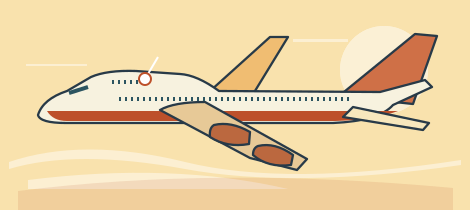
Folding the point of a dart back is an old way to blunt the nose and move paper to the front. Open Flight added a small pleat, so the nose has a step you can feel.
The step is a nod to the raised upper deck of the first Boeing 747, which flew on 9 February 1969. Boeing put the flight deck up there so that cargo versions could open the whole nose. The likeness ends there. The 747 has a tail, four engines and long swept wings. Upper Deck has none of these.
It borrows the step behind the cockpit of the 747, and nothing else.
Try this
Does a paper clip help?
Predict first. Predict first: where will it balance with one clip, and will it fly further? Our estimate: about 10 mm further forward, at 103 mm, with fewer stalls.
- Fold two Upper Decks from the same paper.
- Balance each one on a pencil and mark the spot.
- Slide one 33 mm paper clip onto the nose of one copy. Balance it again.
- Launch each copy five times from the same spot, with the same gentle push.
- Mark where each one first touches the floor.
What to look for. Look for swoops and stalls without the clip, and a longer, flatter glide with it.
Go deeper
Upper Deck is a short, broad flying wing: 144 mm from tip to tip on a 249 mm body. Its aspect ratio, a measure of how slim a wing is, is just 0.64. A simple flat-wing model puts the neutral point, where extra lift acts when the nose rises, 52 mm behind the nose. Swirls of air along the side edges add lift further back, towards the middle of the wing at 135 mm (Polhamus; Torres and Mueller). The balance point is at 114 mm, 41 % along the wing’s average depth, so the plane may be barely steady. Expect a slow, nose-high glide that bobs. Try one nose clip before you bend the back edges: it moves the balance about 10 mm forwards. These figures are estimates from the fold geometry.
Each square metre of wing carries about 137 g (1.3 N/m²), so the model predicts a glide of roughly 2–3 m/s, about jogging speed. Its Reynolds number, which compares speed and size with how sticky the air is, is 30,000–40,000: more than a thousand times lower than a 747 wing in cruise. Contest category: airtime or target games from a gentle launch, not distance. Contests ask for an uncut sheet, so practise with the whole-sheet build.
Sources
- NASA Glenn Research Center · Beginner’s Guide to Aeronautics: Four forces on an airplane · Weight, lift, drag and thrust.
- NASA Glenn Research Center · Beginner’s Guide to Aeronautics: Aircraft center of gravity · Where the weight acts, and how to find it.
- NASA Glenn Research Center · Beginner’s Guide to Aeronautics: Aircraft elevator · How a raised back edge pitches the nose up.
- NASA Glenn Research Center · Beginner’s Guide to Aeronautics: Gliders · Flight with no engine: weight against drag.
- Exploratorium · Paper Airplanes, page 2 · Balance ahead of the lift, nose folds and a bent-up back edge.
- The Museum of Flight · Boeing 747-121 · The first 747 and its raised upper deck.
- G. E. Torres and T. J. Mueller (2004), Low-aspect-ratio wing aerodynamics at low Reynolds numbers, AIAA Journal 42(5) · Measured lift and centre of pressure of short, broad wings at paper-plane speeds.
- E. C. Polhamus (1966), A concept of the vortex lift of sharp-edge delta wings based on a leading-edge-suction analogy, NASA TN D-3767 · Extra lift from the vortices over sharp edges.